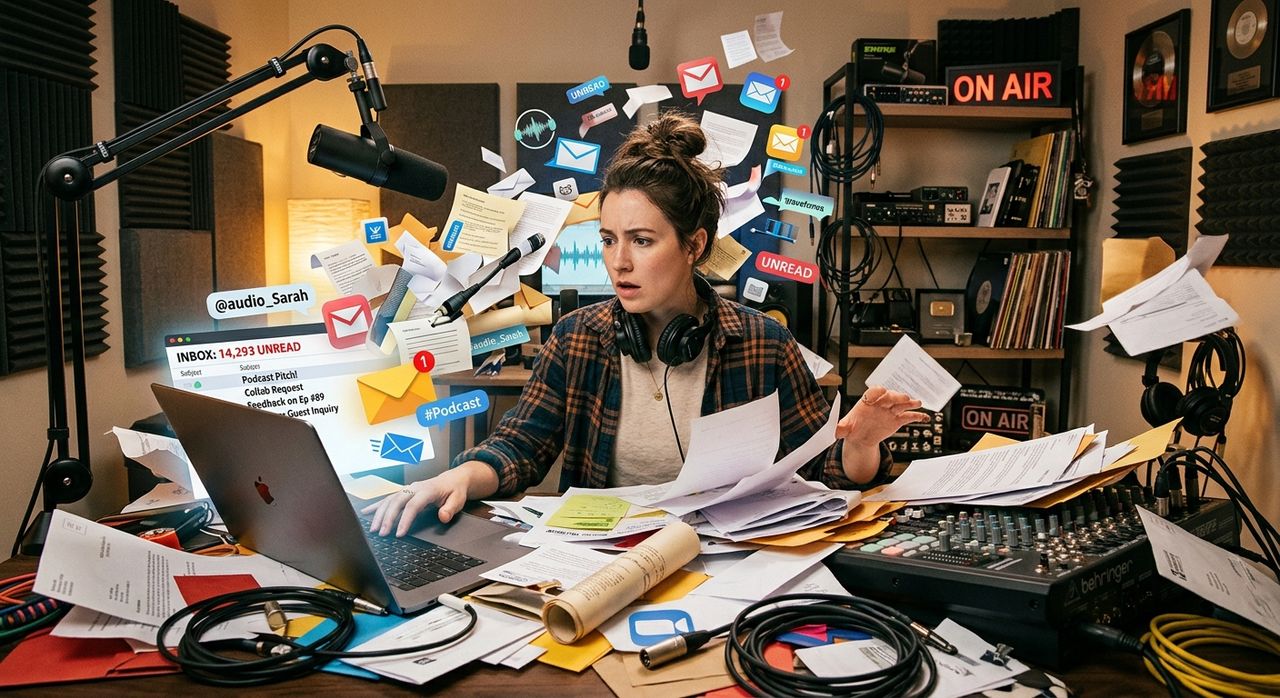
You recorded three episodes, mixed a jingle, and prepped four audio files for a client, all before noon. Then you opened your email. Fifty-three unread messages. Guest pitches from strangers, collaboration requests from artists you admire, follow-ups from clients waiting on deliverables, and listener notes buried somewhere in the middle. Audio creators are among the most productive people on the internet, yet the inbox has a way of making every one of them feel permanently behind.
The Short Version:
1. Audio creators attract constant email from guests, clients, collaborators, and fans simply by publishing regularly.
2. A reply generator removes the blank-page friction, letting you respond to pitches and follow-ups in seconds instead of minutes.
3. An AI inbox sorter flags what needs a reply first, giving back the time you would otherwise spend triaging a flood of messages.
The Double Life of an Audio Creator
Most people outside the industry picture a podcaster or musician sitting in a soundproofed room, headphones on, doing the thing they love. What they don't picture is the hour after the session ends, when the same person switches from creative mode to full admin mode and faces a pile of messages that arrived while they were recording.
This is the double life every audio creator knows. You are simultaneously a producer and a small-business operator. The production side has tools for everything, audio converters, noise-reduction plugins, mastering software. The admin side, particularly email, often gets handled with nothing more than a blank compose window and a sigh.
Why the Inbox Grows Faster Than You Think
There is a compounding effect at play here. The more you publish, the larger your audience becomes. The larger your audience, the more inbound contact you receive. Even a modest show with a few hundred loyal listeners generates a surprisingly large stream of messages each week. Podcast listeners develop a sense of personal connection with hosts, and many of them act on it by reaching out directly.
Add to that the professional side of things. Voice-over artists field client briefs, revision requests, and rate enquiries. Musicians receive licensing enquiries, remix requests, and feature pitches. Every collaboration you accept creates its own thread. Every guest appearance involves at least five back-and-forth messages before the recording even starts.
Researchers who study information overload have documented how message volume has expanded far beyond what human attention can comfortably process. For audio creators who publish regularly and build personal audiences, that effect is especially pronounced.
Here is what a typical week of creator email actually looks like:
- Guest pitches from strangers, often with lengthy bios attached
- Client follow-ups waiting on delivered files or revision decisions
- Collaboration requests arriving from artists in different time zones
- Listener notes praising or pushing back on last week's episode
- Sponsorship enquiries that may or may not match your audience
- Platform notifications mixed in with everything that actually matters
None of those messages are junk. But they all demand different responses, and toggling between them mid-morning breaks any creative momentum you had going.
The Same Mindset That Makes File Conversion Painless
Audio creators already practice efficient tool use in their production workflow. Nobody manually converts a WAV to MP3 by hand. You open a browser tool, drag the file in, and it is done in seconds. The logic is simple: if a tool handles the mechanical part, your attention goes to the creative part.
That same logic applies directly to email. The mechanical part of responding to a guest pitch, a client follow-up, or a collaboration request is not the thinking, it is the writing. Most creators know within thirty seconds whether they want to say yes, no, or "let me check my schedule." The part that takes five minutes is turning that instinct into a polished, professional reply.
This is where the habits of a skilled audio creator, the reflex to reach for the right tool rather than doing everything by hand, transfer directly to inbox management.
Stop Staring at a Blank Compose Window
A well-built email reply generator solves exactly this problem. You paste in the message you received, add a note about your intended tone and any key details you want included, and it drafts a response in seconds.
That draft is not a finished product you send blindly. It is a starting point that handles the hardest part, the blank page. You read it, adjust a sentence or two, and hit send. What used to take six minutes now takes under a minute.
For audio creators specifically, this proves useful across several recurring situations:
- Politely declining a guest pitch from someone who isn't the right fit, without sounding dismissive
- Acknowledging a client's revision request and confirming your delivery timeline
- Responding to a collaboration request warmly but with enough specifics to actually move things forward
- Thanking a listener for meaningful feedback without rewriting the same appreciation note for the fifteenth time
The generator handles the scaffolding. You handle the judgment call. That division of labor is the entire point.
When Volume Is the Real Problem
Sometimes the bottleneck isn't the writing. It is knowing which email to open first. When fifty messages arrive before noon, the challenge is triage, not prose.
This is where an email organizer changes the picture entirely. Instead of scanning subject lines and sender names to figure out what demands immediate attention, the tool does that sorting automatically. Messages that require a response get flagged. High-priority items surface at the top. Everything else waits in its place until you are ready to get to it.
For creators who publish on a schedule, this matters especially. A Monday release means Monday is chaotic. Listener responses, client questions, and collaboration pitches all arrive in the same window. Without some kind of structure, the most important message of the day can sit unread while you respond to something less urgent simply because it appeared first.
The Hours You Actually Get Back
It is worth being concrete about what this kind of shift means in practice. If email currently costs you ninety minutes a day across composing, reading, and triaging, and you can bring that down to thirty, that is an hour returned to your schedule every single day. Over a working week, that is five hours. Over a month, it is close to a full working day.
For a voice-over artist with ongoing clients, that time goes back into recording. For a podcaster, it goes back into research and guest prep. For a musician, it goes back into the studio. This is not a marginal gain. It is a structural shift in how your week is weighted, and it compounds over time as your audience and client list continue to grow.
Your Inbox Is Not the Problem, Your Setup Is
Audio creators are not bad at email. They are trying to manage a professional communication workload with tools that were not designed for people who receive this kind of volume. The inbox itself is neutral. What you do with it depends entirely on the systems around it.
A reply generator that produces a polished draft in seconds and an inbox sorter that knows which message needs attention first, those two tools together change email from a daily obstacle into something you can actually clear before the next recording session starts.
The efficiency mindset you already bring to your audio workflow belongs in your inbox too.