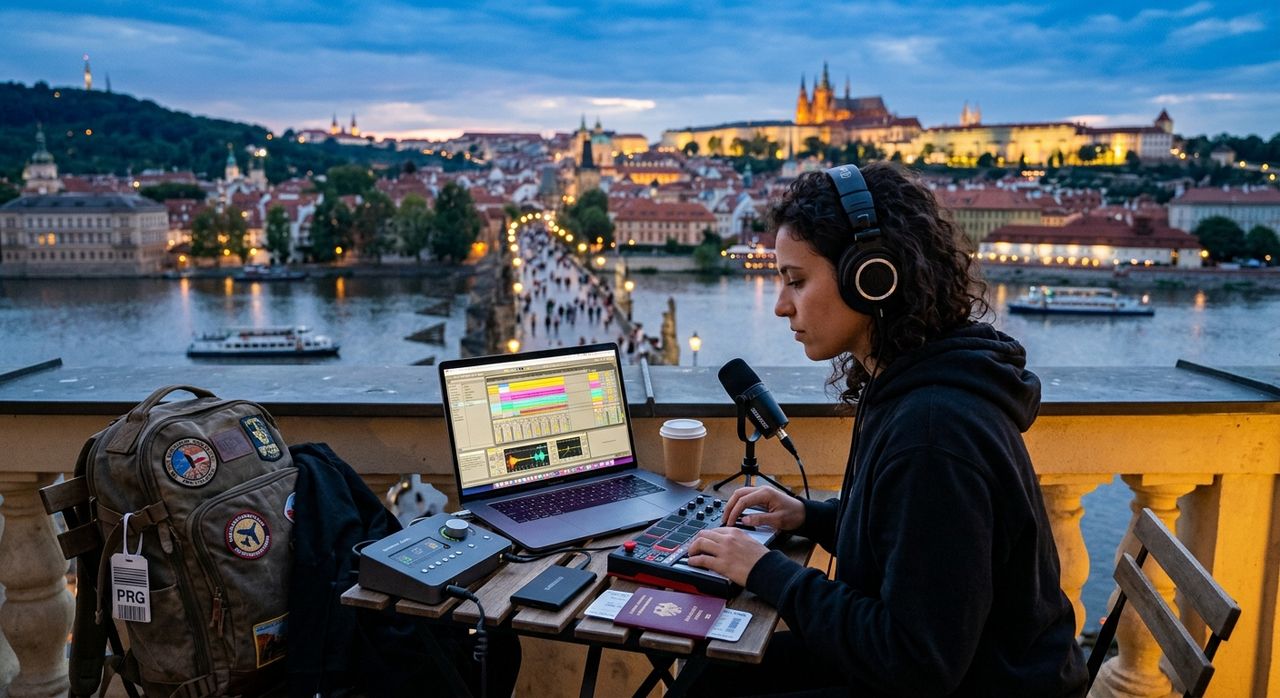
You finish a session in a Tokyo studio at midnight. Your client needs the stems by morning. You plug into the hotel Wi-Fi, fire up your browser, and wait. And wait. The upload creeps along at dial-up speed, then drops entirely. The file is half-sent, the deadline is real, and you have no backup plan. For audio professionals who work across borders, this is not a hypothetical. It happens all the time, and the stakes are always higher than they look on a packing list.
Key Takeaway: Traveling audio creators who depend on cloud tools face a real connectivity gap that hotel Wi-Fi cannot reliably fill. Having your own mobile data connection abroad is the only way to guarantee you can upload, convert, and share files at critical moments. Understanding eSIM options before you depart, researching coverage by destination, and testing a no-cost entry point can make the difference between a smooth project handoff and a missed deadline on the road.
The Gap Between What Hotels Promise and What You Actually Get
Hotel Wi-Fi has a reputation, and it is not a good one. Most hotels sell a single internet connection to dozens or hundreds of guests simultaneously. During peak hours, that bandwidth gets sliced into fractions. Streaming a movie might stutter. Uploading a 500MB multitrack session? That is a different category of problem entirely.
The issue is not just speed. It is consistency. Hotel networks drop out. They redirect your browser to a login portal right in the middle of a transfer. They block certain ports. Some hotels in certain countries run connections through local infrastructure that shapes or throttles international traffic at the ISP level. None of this shows up in the hotel listing, and none of it becomes apparent until you are in the room with a deadline bearing down.
For a casual traveler checking email, these inconveniences are minor. For a field recorder who has spent three days capturing ambient sound in the Scottish Highlands and needs to send high-resolution WAV files to a London editor, or a touring musician who records a soundcheck and wants to back it up before the van breaks down, or a travel podcaster editing in a café in Lisbon and uploading to a host while the episode is fresh, these are professional crises.
Why Audio Files Are Especially Punishing on Weak Connections
Audio files are heavy. A single uncompressed 24-bit stereo recording at 96kHz runs through bandwidth fast. Even compressed files, MP3 or AAC, stack up when you are sending an entire episode or a multi-track project. Cloud audio tools that handle format conversion, normalization, or transcoding depend on getting the file to the server cleanly and getting the processed result back.
Field recording as a practice often puts creators in exactly the wrong environments for reliable internet. Remote locations, regional airports, rural guesthouses, mountain lodges, these are not places with fiber-optic hotel lobbies. Yet the whole point of being in those places is to capture what cannot be captured from a studio, which means the files you are carrying are often irreplaceable.
Breaking a large audio upload mid-stream can corrupt the transferred file or require starting the whole process again. If your cloud converter times out, you lose the processing queue. Some platforms charge per conversion. Others have session limits. In every case, a failed upload is wasted time and sometimes wasted money.
The Case for Your Own Data Connection
The alternative to depending on shared Wi-Fi is bringing your own connection. That used to mean carrying a physical SIM card for each country, swapping hardware, dealing with tiny trays, worrying about losing a chip the size of a fingernail on a hotel bathroom floor. Or it meant renting a mobile hotspot device at the airport, which added bulk, another battery to charge, and a device to return.
eSIM technology, which allows a phone to store multiple carrier profiles digitally without a physical card swap, changed that math. Most modern smartphones support eSIM. You activate a plan through an app or a QR code. You can switch between your home carrier and an international data plan without touching a physical SIM. You land, you flip the active profile, and you have data.
The practical upside for audio professionals is significant. You are no longer at the mercy of whatever the hotel, the café, or the venue is offering. You have a dedicated data connection that travels in your pocket and works as soon as you need it.
Planning Coverage Before You Leave
Not every eSIM provider covers every country equally. Some plans have generous allowances in Western Europe but thin coverage in Southeast Asia. Others work well in urban centers but throttle speeds once you leave city limits. A field recorder heading into the Peruvian Amazon needs different coverage than a touring musician staying in major European venues.
The best move is to research before you pack. Looking through travel destinations and the eSIM plans available for each region gives you a concrete picture of what to expect before you commit to a workflow. If coverage in your destination is strong, you can plan your upload windows around your data connection. If it is patchy, you plan for that too, maybe scheduling large uploads for moments when you can confirm a reliable signal or batching files differently.
Knowing your data situation in advance also helps you decide how to size your sessions. If you are heading somewhere with robust LTE or 5G coverage, you can send full-resolution files without worrying. If coverage is lighter, you might send compressed previews first and hold lossless masters until you hit a verified connection.
Protecting Your Workflow in the Field
There are practical habits that help regardless of connection quality. Keeping a local backup of every session before uploading is non-negotiable. If an upload fails, you want the source file intact and ready to try again. Sending files in smaller batches rather than one massive archive increases the chance that at least some of your work reaches the destination even if the connection drops.
Working with a cloud audio tool that supports paused and resumed uploads is worth paying attention to when you choose your platform. Not all of them handle interrupted transfers gracefully. Some restart from zero. Others pick up where they left off. For large files over mobile data, that difference matters a lot.
It also helps to think about timing. Upload a finished mix during off-peak hours when fewer users are competing for bandwidth on the same tower. If you are using mobile data, find a spot with a strong signal bar before you start, not after. Sitting inside a concrete building or in a basement venue is going to give you a slower connection than standing near a window or stepping outside for five minutes.
The Difference Between a Finished Project and a Missed Delivery
Touring musicians who record live shows have an especially tight window. A rough mix from a Thursday night performance might need to reach a manager or a label by Friday morning for review before the weekend press push. Travel podcasters who record interviews while moving between cities often want to publish while the conversation is still timely. Field recorders working on documentary sound are frequently operating to editorial schedules they do not control.
In all of these cases, the audio does not gain value by sitting on a local drive. It gains value by reaching the next person in the chain. Cloud tools are what make that handoff possible from anywhere. But cloud tools only work when you can actually reach the cloud.
Testing the Water Before You Commit to a Plan
For creators who have never used an eSIM before, there can be a hesitation around switching something as fundamental as how your phone connects to the world. That reluctance makes sense. You do not want to experiment with your connectivity setup the night before an international flight.
A free eSIM offer gives you a way to see how the technology actually works on your specific phone, in your specific situation, without putting any money on the line first. You can verify that your device is eSIM compatible, confirm that the activation process is straightforward, and understand what the plan interface looks like before you are standing in an airport or a foreign hotel needing it to work immediately.
Testing on a domestic trip, or even just activating the eSIM and browsing on it around your own city, removes almost all of the uncertainty. You know what to expect. You know where the settings live on your phone. You know how to switch between profiles. When you land in another country with a deadline waiting, that familiarity is worth a lot.
Staying Audible Across Every Border
The reality of international audio work is that the creative part, the recording, the mixing, the editing, often goes smoothly. It is the logistics that create friction. Getting files where they need to go, at the resolution they need to be, by the time someone is waiting for them, is the unglamorous part of professional audio that most tutorials skip.
A reliable mobile data connection, planned in advance and matched to your actual travel destinations, is one of the simplest upgrades an audio professional can make. It does not change how you record. It does not change how you edit. It just removes the single biggest point of failure between finishing your work and delivering it. That is not a small thing. That is the whole job.