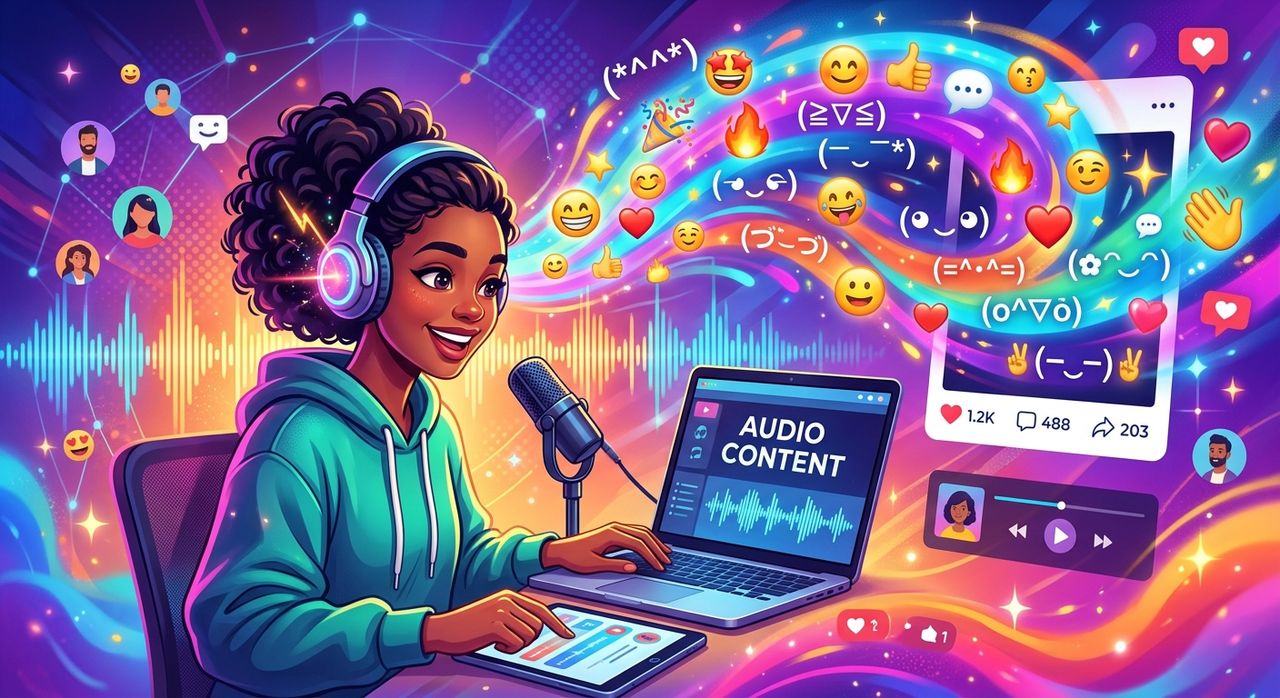
You pour hours into a podcast episode or a music release. The audio is polished. The mix sounds great. Then you write the show notes in plain text and the post lands flat, blending into a wall of words. Visual text elements like kaomoji and emoji are not decoration. They are a functional layer that signals emotion, breaks up dense paragraphs, and draws the eye to what matters, all before a single second of audio plays.
What You Will Take Away:
- Kaomoji are built from standard ASCII and Unicode characters, so they render reliably in RSS readers, email clients, and platforms where colored emoji sometimes fail.
- Emoji used in show notes, social captions, and episode titles improve scannability and can boost click-through rates on social feeds.
- Not all platforms render colored emoji consistently, making character-based text art a smarter default for cross-platform content.
- A dedicated reference for browsing emoji by category or letter saves time when you know the feeling you want but not the symbol name.
- Using these tools intentionally, rather than randomly, keeps your brand voice consistent across every distribution channel.
Why the Text Layer Actually Matters
Audio creators often treat written content as a necessary chore. Show notes exist to satisfy podcast directories. Social captions exist to satisfy algorithms. That framing undersells what the text layer actually does for your audience.
A listener deciding whether to press play on your episode is reading before they are listening. The words, formatting, and visual rhythm of your post are doing sales work on behalf of the audio. A caption that uses a well-placed emoji feels warmer and more personal than a block of plain text. It signals that a human made this, and that human has a sense of tone.
The same logic applies to musicians writing descriptions for singles or albums on streaming platforms, Bandcamp pages, or newsletter blasts. The text is not separate from the creative work. It is the first impression.
The Rendering Problem No One Talks About
Here is something most audio creators do not think about until it bites them. Colored emoji are image-based glyphs. They depend on the operating system, the app, and sometimes the font stack to render correctly. On most smartphones and modern browsers, they look exactly as intended. But RSS readers, email clients, and certain podcast management terminals do not always play along.
That colored microphone emoji you placed in your episode title might show up as a blank rectangle or a generic Unicode square in a listener's podcast app. Some corporate email clients strip emoji entirely. The result is not just a cosmetic issue. It can make your subject line or episode title look broken.
This is where kaomoji become genuinely useful rather than just nostalgic. Kaomoji art is constructed entirely from standard keyboard characters and Unicode text symbols, not image glyphs. A `(^_^)` or a `\(^o^)/` is just text. It renders everywhere text renders. RSS readers display it perfectly. Email clients pass it through without a problem. Terminals show it without a missing-glyph box in sight.
The history of these text-based expressions stretches back to Japanese internet culture in the 1980s, and as covered in the emoticon history entry on Wikipedia, they predate colored emoji by decades. That longevity is not accidental. They work because they rely on the most basic layer of digital communication.
Where to Use Kaomoji in Audio Content
The practical applications for podcasters and musicians are more specific than you might expect. Kaomoji are not replacements for emoji. They fill a different role, one that suits certain content environments better.
Here are the contexts where they shine:
- Email newsletters announcing new episodes or releases, where emoji rendering is inconsistent across mail clients
- RSS feed descriptions, where colored glyphs can appear broken in aggregators
- Transcript headers or chapter markers, where you want a visual break without relying on platform-specific rendering
- Social bios and profile descriptions that get pulled into third-party tools or scraped by bots
- Podcast directory descriptions, where some older directories strip image-based emoji
Using `(~_~;)` to signal something bittersweet, or `( •̀ ᴗ •́ )و` to convey enthusiasm, adds personality without depending on anything outside of plain text.
Emoji Still Have a Strong Role to Play
None of this is an argument against emoji. For social content where you control the platform and your audience is consuming posts natively on Instagram, Twitter or X, TikTok, or YouTube, colored emoji are effective and expected. They increase engagement on social feeds by adding visual contrast in a stream of text-heavy posts.
The practical challenge is knowing which emoji to use in a given moment. Audio creators often have a feeling they want to express but cannot name the emoji that captures it. Searching "happy music emoji" in a browser returns inconsistent results and sends you down a rabbit hole.
A structured emoji A-Z reference solves this faster. You browse by letter or category, preview exactly how the glyph looks, and copy it in one click. For a working podcaster writing five show notes a week or a musician drafting social captions for a release campaign, that kind of lookup tool saves real time.
The broader ecosystem of emoji has also been studied for its effect on digital communication engagement. Research summarized in the emoji Wikipedia overview notes that emoji usage significantly increases emotional clarity in text-based communication, which is particularly relevant when the audio itself is not immediately available to set the mood.
Building a Consistent Visual Voice
Consistency matters more than variety. Picking a small set of emoji and kaomoji that match your brand tone and returning to them repeatedly trains your audience to associate those symbols with your content.
A true crime podcast might lean into minimal, serious emoji and avoid decorative kaomoji entirely. A music producer with an upbeat, maximalist style might use expressive kaomoji in newsletters and bold emoji clusters on social posts. Neither approach is wrong. What damages a brand is inconsistency, using a tearful face emoji one week and an explosion the next with no connective logic.
Think of it as a visual vocabulary. Just as you have a consistent way of speaking in your audio, you can have a consistent set of text-based signals that show up across show notes, email, and social captions.
Your Audio Deserves Text That Keeps Up
The audio you produce is specific, deliberate, and crafted with care. The text that surrounds it should match that standard. Kaomoji offer a cross-platform reliability that colored emoji cannot always guarantee, making them the smarter default for newsletter subject lines, RSS descriptions, and any environment outside of a fully modern social app. Emoji, used with a reference to hand, bring warmth and scannability to platforms where image rendering is solid.
Together, they give audio creators a text layer that works as hard as the audio itself, one that catches eyes before ears, and holds attention long enough to earn the play.