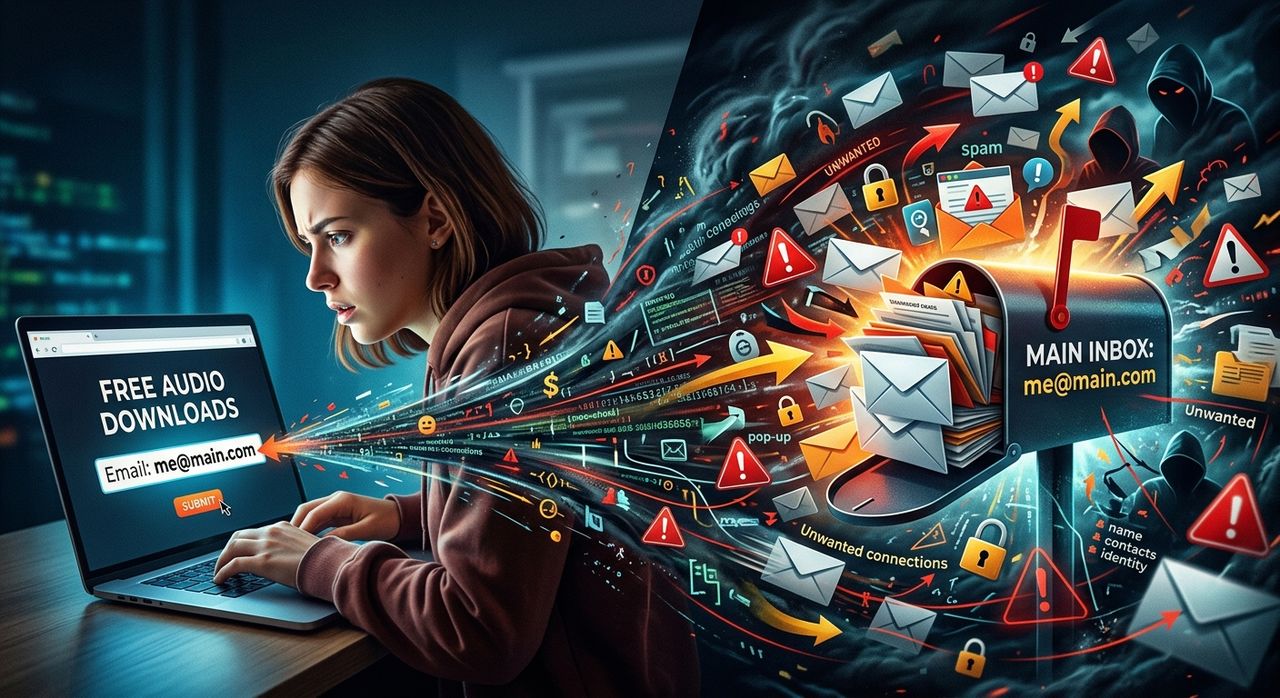
You grabbed a free sample pack last Tuesday. By Thursday, your inbox had seventeen new marketing emails from brands you barely recognized. Sound familiar? It happens to almost every music producer who downloads free audio assets, and the reason has nothing to do with bad luck. It is the direct result of a business model that treats your email address as the product, not the giveaway.
Key Takeaway:
- Free audio sites routinely collect and resell your email address to third-party marketers.
- A single download can trigger spam from dozens of unrelated companies within days.
- Your productivity suffers when your music workflow inbox becomes a marketing dump.
- Using a temporary address for download signups keeps your real inbox completely clean.
- This habit takes seconds to build and saves hours of inbox management over time.
Why Free Audio Sites Want Your Email Address
The economics of free content are straightforward. Someone is always paying, even when the download costs you nothing. For most sample pack libraries, loop repositories, and VST plugin marketplaces, the currency is your contact information.
When you sign up to grab a free reverb preset or a collection of drum loops, that email address enters a database. Sometimes it stays there and the company markets to you directly. That is annoying but manageable. The real problem happens when the site monetizes that list by selling it, licensing it, or sharing it with affiliate partners who have no direct relationship with you at all.
Email spam has been a documented problem since the early days of the internet, and the underlying mechanics have not changed much. What has changed is the sophistication of the list-building operations behind it. Today, a single signup on a free audio platform can route your address to multiple advertising networks before the download even finishes loading.
How the Cycle Gets Worse Over Time
Here is where it turns into a real headache. Once your address is on one list, it tends to appear on others. Data brokers aggregate contact information from multiple sources and resell bundled lists to marketers. So those seventeen emails you got from that one sample pack download? Some of those senders never had any direct relationship with the site you signed up on. They bought your address from a third party who bought it from someone else.
For music producers, this pattern compounds because the hobby itself encourages frequent downloading. You might grab a free piano VST on Monday, a royalty-free hip-hop break kit on Wednesday, and a collection of ambient textures over the weekend. Each signup is another entry point for your address into a new marketing pipeline. Within a few months, an inbox that was once clean becomes a firehose of promotional content.
The collateral damage is real. Important emails from collaborators, sync licensing partners, or your DAW's support team get buried under noise. You start missing things that matter because the signal-to-noise ratio has collapsed completely.
What These Sites Actually Do with Your Data
Not every site is equally aggressive, and it is worth understanding the range of behaviors you are dealing with. Some platforms are genuinely respectful of your data and only use your email to send updates about their own products. Others are at the far end of the spectrum, treating signups as a revenue stream in their own right.
The middle ground is where most producers get caught off guard. A site might not actively sell your data, but their privacy policy allows them to share it with "partners" or "affiliates." That is a legal gray area that produces the same practical result: strangers showing up in your inbox.
Three Levels of Email Risk from Audio Downloads
- Direct marketing: The site keeps your email and markets their own products to you. Annoying but predictable, and you can usually unsubscribe without much trouble.
- Affiliate sharing: Your address goes to a small network of related companies, usually in the same music tech space. More emails, but somewhat contained in scope.
- Third-party resale: Your address ends up on a broker list and gets sold to buyers with no connection to audio or music at all. This is where the truly irrelevant spam originates, the fitness supplements, the financial offers, the survey invitations.
The Inbox Damage You Are Actually Paying For
Think about the time cost. Filtering spam, unsubscribing from lists, checking junk folders for real messages that got misclassified. For producers juggling sessions, deadlines, and client communication, that overhead is a genuine productivity drain that never appears on any budget but costs real hours every month.
There is also a subtler cost. When your inbox becomes unreliable, you start to disengage from it. You check it less carefully. You skim instead of read. You miss a collaboration request or a sync licensing inquiry because it arrived the same day as forty promotional emails and got swallowed by the noise.
The Tools You Use Most Are the Ones Being Targeted
Royalty-free track sites, loop libraries, VST marketplaces, and sample pack repositories are among the most prolific email collectors in the creative space. The reason is obvious: the audiences they attract, music producers, beatmakers, and sound designers, are valuable to a huge range of adjacent industries. Audio interfaces, headphones, online mixing courses, music distribution services, and general software tools all want access to that demographic. Your email address is the key that opens that door.
Before You Download, Build This One Habit
The practical fix is simple and takes almost no extra time once it becomes routine. Before you sign up on any free audio download site, use a fake email for that session and complete the signup with it. The confirmation arrives, you click through, you get the file, and then the address expires. Nothing follows you home, because there is no permanent address to follow.
This single habit, spending five extra seconds before any download signup, eliminates the entire category of third-party spam in your main inbox. You are not blocking the download. You are not violating any terms. You are just choosing not to hand over a permanent contact point to a system that will likely misuse it.
What You Should Actually Protect Your Real Email For
Your main email address has genuine value. It is the contact point for your collaborators, your plugin license registrations, your DAW account, your streaming distribution profile, and any professional relationships you are building in the industry. Every unnecessary exposure increases the probability that it ends up somewhere you never intended.
A useful filtering rule is to ask one question before any signup: will I genuinely want to hear from this organization again, in a year, about something relevant to my work? If the answer is no, or if you are unsure, use a temporary address. Reserve your real email for the relationships and services that actually deserve that access.
What Changes When This Becomes Second Nature
The difference in inbox quality is noticeable within a few weeks of adopting this habit. When you stop feeding your real address into download gates, the volume of incoming promotional mail drops significantly. The messages that do arrive become more relevant because they come from sources you deliberately chose.
Your session workflow improves too. When your music production inbox is clean and trustworthy, you process it faster, rely on it more, and use it as an actual communication tool rather than a daily spam management chore. That adds up to more time in your DAW and less time doing inbox triage.
Your Inbox Is Part of Your Studio
Music producers spend serious effort optimizing their signal chain, their room acoustics, and their plugin routing. The inbox deserves the same intentional approach. Right now, for most producers who download free assets regularly, the inbox is misconfigured. It is letting noise in because the default behavior, entering your real email into every signup form, is simply the path of least resistance.
Adjusting that one default does not require new tools, subscriptions, or technical knowledge. It just requires treating your email address with the same care you give every other part of your creative setup. Your studio is where the work happens. The less noise coming in from every direction, the more clearly you can hear what actually matters.