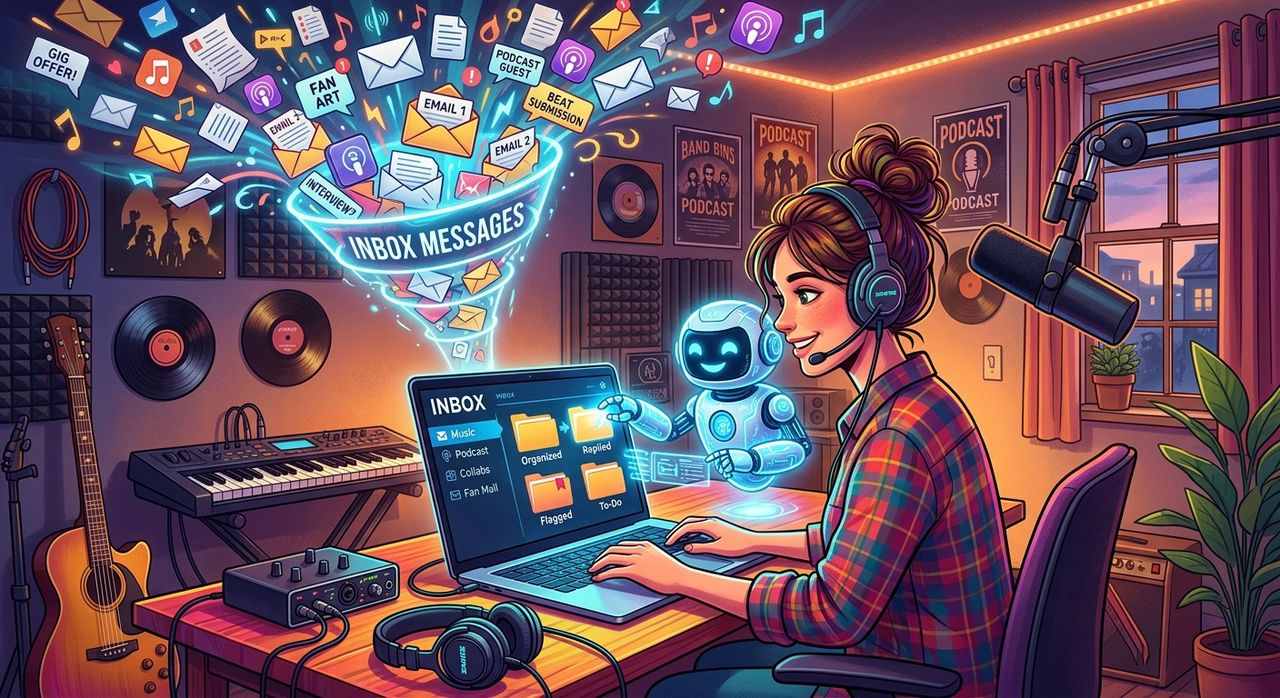
If you are an independent musician or podcast producer, your inbox is basically a second job. Collaboration pitches land at 11pm. Booking inquiries need a response before the venue gives the slot to someone else. Sponsor negotiations stretch across a dozen threads before a single dollar is agreed on. Before you know it, Wednesday is gone and you have not touched a single track or recorded a single word.
Key Takeaway:
- Independent creators spend a disproportionate part of their week on email rather than making things
- AI drafting tools generate first-draft replies and outreach in seconds, not hours
- Collaboration calls with co-hosts or producers generate follow-up tasks that AI can capture automatically
- Tools trained on your own writing style produce replies that sound personal, not robotic
- Reclaiming inbox time is one of the most direct ways to protect your creative output
The Email Problem Nobody Talks About
There is a version of the creator life that looks glamorous from the outside. Recording sessions, live performances, guest interviews. What the highlight reel skips is the unglamorous hours spent crafting a polite but firm reply to a brand that wants a 30-second ad read in exchange for a free product worth less than the time you just spent on the email.
The podcast industry has grown into a space with tens of millions of active shows worldwide. That growth means more competition, more outreach, and more email in both directions. Musicians face the same pressure. Labels, playlist curators, sync licensing contacts, venue bookers, and potential collaborators all expect timely, professional communication.
The problem is not that the emails are hard to write. Most of them follow recognizable patterns. The problem is volume combined with context-switching. Every time you stop thinking about a melody to compose a pitch email, you pay a cognitive toll that takes time to recover from.
Why Context-Switching Is the Real Creativity Killer
Research on human attention consistently shows that switching between creative tasks and administrative tasks is not free. You do not just pause creative work and resume it. You restart it. The ideas you were holding in mind dissipate. The groove you were in is gone.
For independent creators without an assistant or manager, email is the main source of that context-switching. A session musician fielding gig requests, a podcast host managing guest coordination, a bedroom producer negotiating sync deals: all of them are doing work that a full-time assistant would handle at a label or production company.
The good news is that the patterns in creator email are predictable enough for AI to handle the heavy lifting.
What AI Actually Does With Your Inbox
The practical value of AI email drafting is not that it replaces your judgment. It handles the first draft so your judgment only has to step in at the editing stage.
Here is how that plays out for a working musician or podcaster:
- A venue sends a booking inquiry asking about your availability, technical rider, and fee range. Instead of opening a blank reply, you describe the context and get a professional first draft in seconds.
- A potential sponsor reaches out about a mid-roll integration. The AI drafts a response that covers your standard rates, deliverables, and turnaround timeline.
- You are pitching a collaboration to an artist whose work complements yours. Rather than staring at a blank screen, you generate a warm but direct outreach email that you then personalize.
- A listener emails asking about your recording setup. The AI drafts a friendly, detailed reply using your established tone.
- A publicist follows up on a placement you submitted three weeks ago. You get a tactful check-in email drafted before you have finished your coffee.
In each case, you are not handing control to the AI. You are eliminating the blank-page problem and reducing a fifteen-minute task to a two-minute one.
The Types of Emails That Eat Creator Time
Not all creator email is equal. Some types drain more time than others:
- Booking and availability inquiries that require checking your calendar and communicating logistics
- Collaboration pitches where you need to communicate enthusiasm without overselling
- Sponsor negotiation threads that require back-and-forth over rates, deliverables, and timelines
- Guest coordination emails for podcast appearances, including pre-interview briefs and follow-ups
- Fan or listener engagement that you actually want to respond to personally but never seem to get to
The first three categories are where AI drafting pays off most immediately. They are professional communications with predictable structures, and every hour you spend on them is an hour not spent in the studio or behind the mic.
When the Call Ends and the Follow-Up Begins
Email is only part of the administrative burden. Remote collaboration is the other half.
Co-hosts record planning sessions over video calls. Producers and artists talk through arrangements in long calls that generate action items nobody fully remembers by the following morning. Guest pre-interviews surface information that should inform questions but gets lost in the shuffle.
This is where AI meeting notes make a concrete difference. Instead of trying to type notes while staying present in the conversation, you let the AI capture the call. What comes out on the other side is a structured summary: decisions made, tasks assigned, follow-up questions flagged. You walk away from the call knowing exactly what the next step is and who owns it.
For podcast teams specifically, this matters at scale. A show releasing two episodes per week might have four or five planning calls, guest calls, and sponsor check-ins in that same period. Without structured notes, things slip through. With them, production runs tighter and guests get a better experience.
The Worry About Sounding Like a Robot
Every creator who considers using AI for email hits the same wall. The emails will sound generic. Recipients will be able to tell. The personal touch that built their audience or their professional relationships will disappear.
This concern is reasonable. It is also solvable.
The key is using a tool that learns your actual writing style rather than applying a default template. Reply identity technology works by analyzing your existing emails and calibrating to the patterns in how you communicate: your vocabulary, your sentence length, your level of formality, your characteristic phrases. The drafts it produces do not read like corporate boilerplate. They read like you wrote them on a day when you had more time than usual.
For creators, this is more important than in most other professions. Your audience follows you in part because of how you communicate. That voice should carry over into your professional emails, not disappear the moment you are responding to a booking agent.
Protecting Your Creative Hours
The practical goal here is not to automate everything. It is to protect a specific resource: the uninterrupted creative time that your work actually depends on.
Consider what a realistic redistribution of email time looks like:
- Checking and triaging the inbox once or twice a day instead of reactively
- Using AI drafts as starting points, then editing for accuracy and personal detail
- Sending better, more professional emails faster, which often accelerates responses
The music industry rewards persistence and professionalism in equal measure. Slow or inconsistent communication costs bookings, collaborations, and placements that never happen because you were too buried in your current inbox to follow up on the last one.
Making the Transition Without Losing Your Voice
If you are starting to use AI tools for your inbox, the onboarding matters. A few practical steps:
- Start with lower-stakes emails where the cost of an impersonal draft is low
- Read every draft out loud before sending it. If it does not sound like you, fix it before it goes out
- Gradually apply it to higher-stakes threads as you build confidence in the outputs
- Keep editing. The AI handles the first draft; your edits are what make it real
Over time, the tool gets better at matching your style, and you get faster at editing because you know what to look for.
Where Your Hours Actually Go
Here is the part most creators skip when they think about their week. The hours spent on email are not neutral. They come from somewhere. Usually they come from the morning creative session that gets pushed back until afternoon, then until tomorrow, then until next week.
AI does not make you more creative. It does not write your songs or produce your episodes. What it does is reduce the friction between you and the work that actually matters. The inbox gets handled. The follow-ups go out. The collaboration calls produce usable notes. And you get back to the microphone or the mixing desk without carrying three half-written emails in your head.
That is not a small thing. For independent creators working without a team, it might be the most practical change available right now.
Your Inbox, Finally Working for You
The creators who thrive long-term are not necessarily the most talented. They are the ones who build sustainable systems around their work. Communication is a system. Right now, for most independent musicians and podcasters, it is a broken one.
AI does not fix everything. But it fixes the part where you stare at a blank reply field for ten minutes before writing three sentences you could have written in thirty seconds with a starting point. It fixes the part where a great planning call produces zero written record by the next morning. And it fixes the part where you worry that efficiency means sacrificing the personal touch that makes your communication feel like it comes from a real person.
Your voice is still yours. AI just helps you use it more of the time on things that actually matter.