If you spend your days editing audio, mixing tracks, or obsessing over the tiny details in a waveform, you've probably wondered whether all that listening is doing something to your brain. The science says yes, and it's more specific than you might expect. Musicians don't just hear differently. They react differently, too.
Key Takeaways:
- Music training measurably speeds up auditory processing at a deep neurological level, not just at the conscious listening stage
- Trained musicians tend to react 40 to 80 milliseconds faster than non-musicians on audio-triggered tasks
- The average person clocks in at 220 to 260 ms on a standard visual reaction test
- Benchmarking yourself with a reaction time test takes under a minute and gives you a real data point to work from
- Your keyboard or mouse adds its own delay, so ruling out hardware lag before drawing conclusions is worth the extra step
What Reaction Time Actually Measures
Reaction time is the interval between a stimulus and your response to it. Simple as it sounds, it involves a chain of events: your sensory system picks up the signal, your brain processes it, and your motor system fires. Each link in that chain has its own latency.
For most people, simple reaction time, meaning one stimulus and one response, sits somewhere between 150 and 300 milliseconds. That's not very long, but at the scale of music, 300 ms is a quarter note at 50 BPM. It's the gap between a beat landing and your body catching up. Musicians are acutely aware of that gap, even if they don't think of it in those terms.
Auditory reaction times tend to be faster than visual ones. Your ears process sound about 20 to 40 milliseconds faster than your eyes process light, on average. This matters when studying musicians, because most music practice runs through the ears. That's the channel that gets refined over thousands of hours of focused work.
The Research Linking Music Training to Faster Processing
The connection between musical training and cognitive speed isn't new. Researchers have been building that case since at least the 1990s. According to research compiled under music and the brain, structured musical training changes the way the auditory cortex handles incoming signals. The brain gets better at predicting, filtering, and responding to sound over time.
A Northwestern University study from 2013 found that trained musicians had faster and more consistent auditory brainstem responses than non-musicians. The brainstem response is deep and automatic, well below conscious control. It happens before you even decide to react. The fact that musicians show faster responses at that level suggests training rewires the early stages of auditory processing, not just the conscious listening skills you'd expect from practice.
What this looks like in real testing data follows a clear pattern:
- Musicians pick up the onset of a sound faster than non-musicians
- They distinguish between two closely timed sounds more reliably under pressure
- They maintain their reaction speed under noise and distraction better than untrained listeners
- They show less variability across repeated trials, meaning they're more consistent rather than just occasionally fast
That last point is underappreciated. Being fast once isn't useful in music. Being consistently fast across hundreds of notes in a single performance is what actually matters, and that consistency shows up on standardized tests too.
Average Scores and What They Tell You
Here's what the data tends to show when musicians and non-musicians take standard reaction time benchmarks side by side.
Non-musicians typically average somewhere between 220 and 260 milliseconds on a simple visual reaction test. On audio-triggered variants, that drops a bit, often landing in the 190 to 230 ms range.
Trained musicians cluster lower. Instrumentalists often land between 160 and 200 ms on visual tests, and some drop below 160 ms on auditory cues. At 180 ms versus 240 ms, that 60-millisecond gap is the difference between catching and dropping a beat at 250 BPM. It's not subtle once you hear it in context.
Audio engineers and producers without formal instrument training tend to fall somewhere between those two groups. They've trained their ears extensively through years of critical listening, but the motor coupling that comes from playing an instrument isn't there. The brain adapts to what you practice. Listening trains perception; playing an instrument trains perception and response together, and those are meaningfully different things.
Does Genre or Instrument Make a Difference?
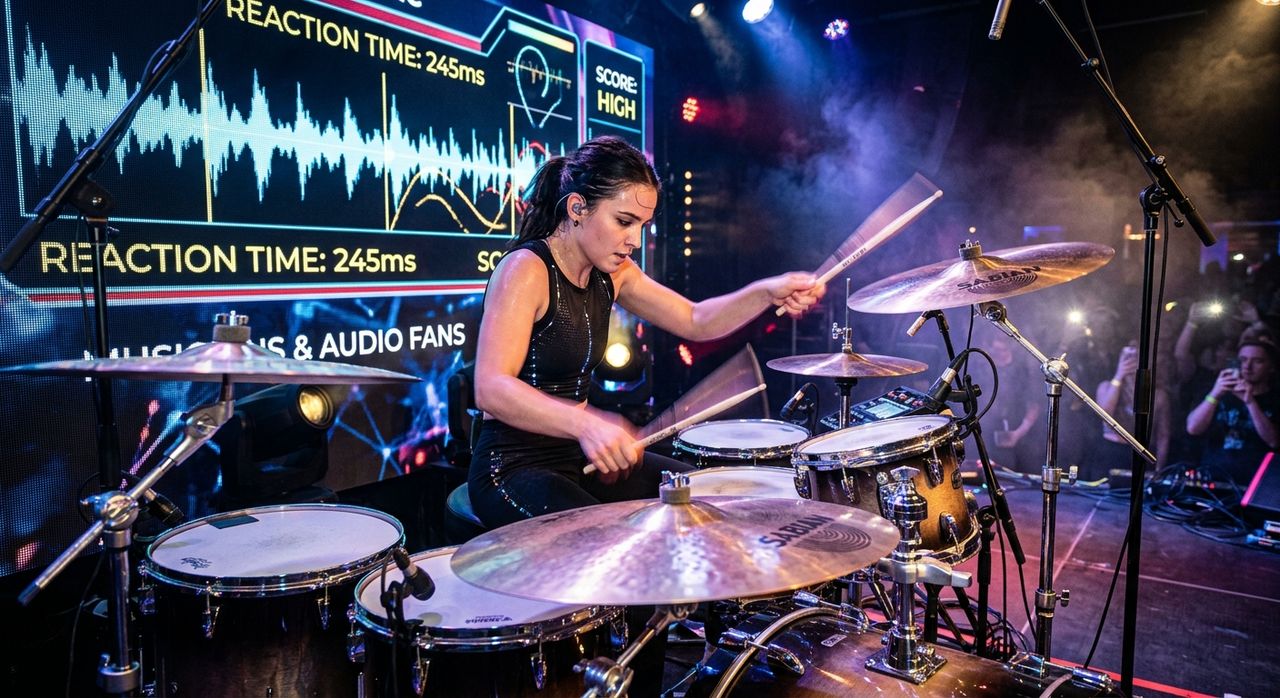
Percussionists tend to score the fastest in most studies. That makes intuitive sense. Their practice is built entirely around precise timing at the millisecond level. A drummer who lands 20 ms late on the snare doesn't need a lab to tell them something went wrong. The feedback is immediate, social, and often pretty loud.
Guitarists and pianists show strong scores too, especially on tasks that use audio cues rather than visual ones. Wind players are interesting because they often show high scores on auditory discrimination even when their raw reaction time is close to string players. The breath control and phrase shaping involved in wind playing may train a slightly different set of cognitive resources, ones that show up more in precision than in raw speed.
Vocalists are harder to study cleanly. Voice is the most continuous of instruments, and reaction time tasks reward discrete, snappy responses. But vocalists who also play an instrument tend to show musician-level scores regardless, which suggests the instrument practice is doing most of the neurological lifting.
How to Actually Benchmark Yourself
If you're curious where you actually land, the most direct way to find out is to take a reaction time test and collect a few trials. The test presents a simple stimulus and measures how fast you respond. It's not a controlled lab setup, but it's repeatable, free, and backed by a large enough sample size to give you meaningful comparative data.
A few things worth knowing before you sit down to test.
You'll likely get faster over the first three to five trials as you warm up and settle into the rhythm of the task. The first trial almost always reads slow. Fatigue has the opposite effect, and even mild tiredness adds 30 to 50 ms to most people's scores, sometimes more.
Time of day matters more than people expect. Most adults react fastest in the late morning to early afternoon, when alertness peaks naturally. Late-night sessions are great for production work, but they're probably not when you'll set a personal best on a reaction time benchmark.
Caffeine helps in the short term. Two to three cups of coffee can shave 10 to 20 ms off average scores, which is real but not dramatic. Training and sleep are the bigger variables.
One Source of Lag You Might Be Ignoring
Here's something most people skip over. Your hardware has its own reaction time.
If you're clicking a mouse or pressing a key, the delay between your finger moving and the signal registering is not zero. Budget peripherals can add 10 to 30 milliseconds of input lag. Some older or cheaper switches are inconsistent, layering variable delay on top of that fixed one. If you're trying to measure human reaction time at millisecond precision, and your input device is contributing 25 ms of random noise, your data isn't clean.
Running a keyboard tester before you benchmark helps you understand whether your hardware is adding variance to your results. If you're pressing keys and seeing late or inconsistent registration, the problem may not be your nervous system. It's worth separating those two sources of delay before drawing any conclusions about your own reflexes.
What Fast Scores Mean for Real Audio Work
A low reaction time number is satisfying to see. But it's worth being honest about what it does and doesn't mean for the work most audio people actually do.
Fast reaction time helps in live performance and live sound contexts. Session musicians, monitor engineers, and anyone processing real-time audio benefit from being able to respond to what they're hearing with minimal lag. A fast nervous system means tighter timing, more responsive decisions at the board, and less cognitive overhead when something changes mid-performance.
For studio work, raw speed matters less. Editing, mixing, and mastering are deliberate processes with plenty of room to review and undo. What matters there is accuracy, pattern recognition, and the ability to hear tiny differences in timbre, timing, and space. Those are related to auditory processing speed but they're not the same thing as the number you see on a reaction time test.
The interesting finding is that most audio professionals, whether they've played an instrument or just spent years in front of a DAW, tend to score above average. Their brains have been shaped by close, repeated listening. The benchmark just gives you a number to attach to that intuition.
The Millisecond Gap Between Training and Talent
The evidence that music training sharpens auditory processing is solid. The gap between trained musicians and untrained listeners is real and measurable, and it shows up not just in self-reported listening skills but in brainstem responses that happen below conscious awareness. That's about as deep as this kind of research gets.
But the more interesting question isn't whether musicians are faster in the abstract. It's whether years of serious audio work, even without formal instrument training, has been moving the needle for you specifically. The benchmark gives you a data point. The hardware check gives you a cleaner one. What you make of either is up to you, but at least now you have a way to find out.