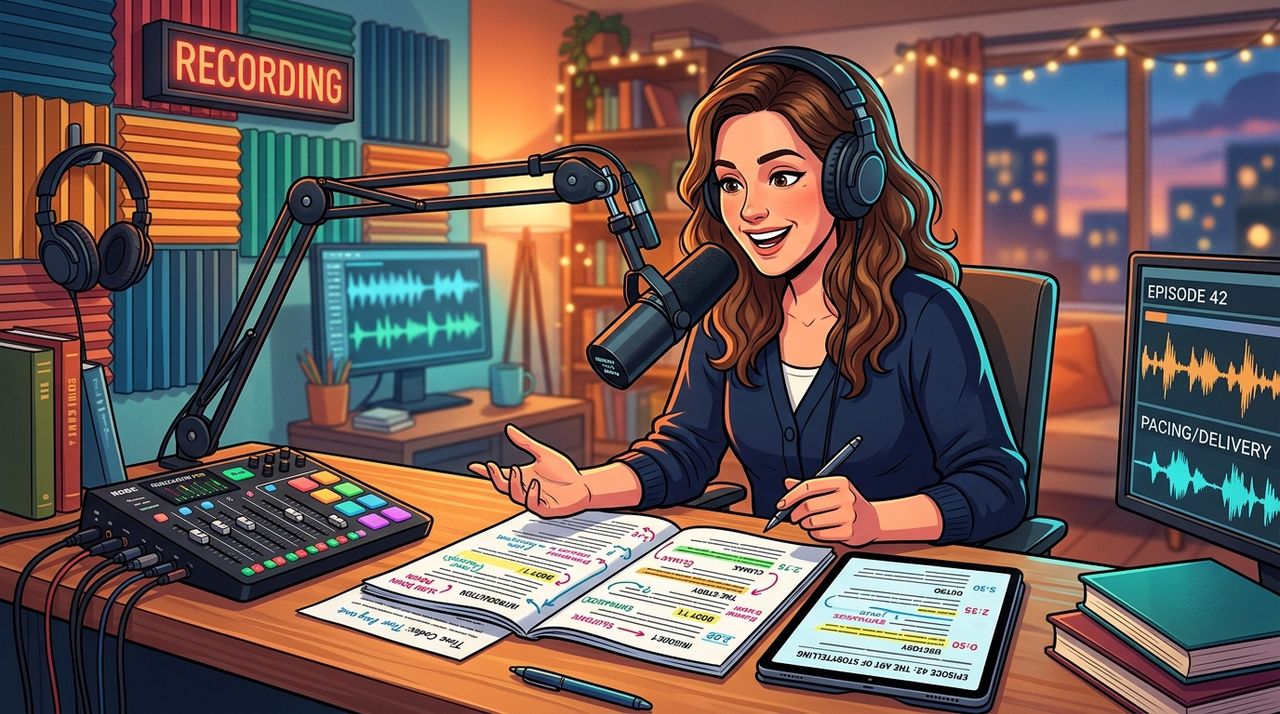
If you've ever listened back to a raw recording and cringed at the rambling, the dead air, or the fourth time you tried to explain the same point, you already know the problem. Podcasting sounds casual, but casual does not mean unplanned. The hosts who sound the most natural on air are often the most prepared behind the scenes. For audio creators who record, edit, and convert their episodes, a solid script is not a creative cage. It is a time machine. It saves you hours you would otherwise spend in post-production fixing problems that never had to exist.
Key Takeaway: Pre-scripting your podcast before you hit record dramatically cuts re-takes, awkward pauses, and post-production cleanup time. When you know exactly what you want to say, your delivery gets sharper and your editing session shrinks from hours to minutes. A script also gives you a concrete way to verify episode length before recording begins, so you stop guessing and start producing with confidence.
Why Scripting Feels Scary (And Why That Fear Is Wrong)
A lot of podcast hosts resist scripting. The worry is that reading from a page makes you sound stiff, robotic, or like a news anchor from 1987. That fear is understandable. But it is also based on a misunderstanding of what a podcast script actually is.
A script is not a teleprompter. It is not a legal brief. A good podcast script reads the way you talk, with short sentences, informal phrasing, and room for personality. When you write it in your own voice and practice it a few times before recording, it stops sounding scripted. It sounds confident. The difference between a host who stumbles through their material and one who sounds effortlessly authoritative is usually preparation, not talent.
Podcasting as a format has grown massively since its early days, and listener expectations have grown with it. Audiences today are used to high-production audio. They notice when a host loses the thread, over-explains, or spends two minutes getting to a point that could have landed in thirty seconds. Scripting fixes all of that.
The Real Cost of Skipping the Script
Going into a recording session without a script feels free. You can riff, respond naturally, and follow your thoughts wherever they lead. In practice, what usually happens is different.
You repeat yourself. You go on tangents that eat up five minutes of runtime and add nothing to the episode. You lose your train of thought mid-sentence and spend three seconds saying "um" while your brain catches up. None of that is bad on its own. Every host does it. The problem is that every one of those moments has to be fixed in post-production, and fixing audio takes time. Cutting a stutter, re-splicing a sentence, or trimming a two-minute detour that kills momentum means more time in your editing software and more chances to introduce artifacts, mismatched room noise, or awkward transitions.
When you script your episodes, you go into the recording room knowing what you're going to say. Your recording is cleaner. Your edit is faster. And the final file you export, whether you're converting to MP3, AAC, or anything else, represents the episode you actually planned to make.
Planning Your Script Length Before You Write a Word
The planning stage is where most podcast episodes go wrong, and it happens before a single sentence is written. Hosts tend to have a vague sense of how long they want an episode to be, say thirty minutes, and then they write until it feels like enough. That approach almost always produces episodes that run too long, too short, or unevenly paced.
A better approach is to use a reading time calculator on your draft script before you record. Paste in what you've written and get an estimate of how long it will actually take to read aloud. This is a sanity check, nothing more. It tells you immediately if your twenty-minute outline is actually a forty-minute script, or if your planned half-hour episode is going to clock in at eighteen minutes and feel thin.
This matters especially because reading time estimates for spoken audio differ from reading time for articles. You're not scanning a page. You're speaking, breathing, pausing for effect, and giving listeners time to absorb what you're saying. A reading time estimate gives you a baseline so you're not walking into your recording session blind.
Matching Word Count to Your Target Episode Runtime
Once you have a draft script and a sense of your target length, the next step is to check whether your word count actually matches how long you speak. This is where a lot of creators are surprised.
Most people assume they speak faster or slower than they actually do. The average conversational speaking rate sits around 130 to 150 words per minute, but podcast hosts often speak faster when they're excited about a topic or slower when they're being deliberate and thoughtful. Neither is wrong, but if you don't know your actual pace, you can't write a script that hits your target runtime.
Running your script through a WPM calculator before you record lets you enter your word count and your target duration, and see whether they match. If your 4,000-word script would take you 22 minutes at your natural pace but you're aiming for 30 minutes, you know to add more content, slow down your delivery, or add structured pauses. If you're over, you know to cut. Either way, you're not discovering the problem at the 45-minute mark of a recording you have to re-do.
Research on speaking rate and comprehension confirms that listeners process audio most comfortably in a specific pace range. Scripting to your natural WPM keeps you in that range without effort.
What a Good Podcast Script Actually Looks Like
A podcast script does not have to be a word-for-word read. In fact, for many hosts, a hybrid approach works better than a full transcript. Here is what that can look like in practice:
- A fully written introduction and closing, recorded clean and with no ad-libbing
- Bullet-point outlines for the body sections, where you know the main points but fill in the conversational details naturally
- Full scripted transitions between sections, so you never lose momentum moving from one topic to the next
- Any statistics, quotes, or precise information written out word for word, so you never fumble with numbers on air
The sections that benefit most from full scripting are the ones where precision matters: your opening hook, your key argument, any call to action, and your outro. The rest can flex.
Recording from a Script Without Sounding Like a Robot
The single biggest mistake hosts make when recording from a script is reading it too carefully. They track the words on the page so closely that their voice loses its natural rhythm. You hear it immediately. The energy drops, the pacing gets mechanical, and the listener can feel that something is off even if they can't name it.
A few habits that fix this:
- Read your script out loud at least twice before recording. Your mouth needs to know the words before your voice can make them sound natural.
- Write contractions everywhere. "You are" sounds stiff. "You're" sounds like a person talking.
- Write short sentences. Long compound sentences are hard to deliver smoothly and hard to listen to.
- Mark your pauses in the script itself. A double space or a slash mark between sentences reminds you to breathe and let points land.
- Record in chunks, not all at once. Script your episode in sections and record each section separately if needed. Your editing software will put them together cleanly.
Practice is the real differentiator. Hosts who have scripted fifty episodes sound completely natural doing it. It becomes muscle memory.
Fewer Re-Takes, Cleaner Files, Faster Exports
Here is what scripting does to your production workflow in practical terms. Your recording session is shorter because you know what you're saying and you say it. You don't restart mid-sentence because you lost the plot. You don't record fifteen minutes you'll never use. Your raw file is tighter from the first take.
Your editing pass is faster because there's less to cut. Fewer filler words, fewer tangents, fewer moments where you stopped and restarted. The cuts you do make are cleaner because you're trimming between scripted beats, not hunting for the one good version of a rambling thought buried in twenty minutes of audio.
And when you get to your conversion and export stage, the file you're working with is the episode you intended to make. No surprise runtime, no scrambled structure, no section that should have been cut three weeks ago. What you wrote is what your listeners hear.
The Script Is Where the Episode Really Gets Made
Recording is not where great podcast episodes are built. Recording is where a well-built script gets performed. The creative decisions, the structural choices, the pacing judgment, all of that happens at the writing stage, before a microphone is ever switched on.
Hosts who treat scripting as part of the production process, not a separate chore, find that every step after it gets easier. The recording is calmer. The edit is faster. The final export is cleaner. And the listener on the other end hears exactly what you meant to say, delivered the way you meant to say it. That is what separates a polished podcast from one that almost got there.